
Will your pack survive on shelf?
Most brands assume the pack that worked online will also work in-store. But retail shoppers decide very differently.
See how your audience actually sees your product on shelf.
In retail, shoppers aren’t analysing packaging. They’re scanning, pattern-matching, avoiding risk and filtering out far more information than they take in.
Most pack testing does the opposite. Slowing people down and asking them to consciously evaluate designs in an artificial context, rather than as they would in the real world, as part of a competitive retail fixture.
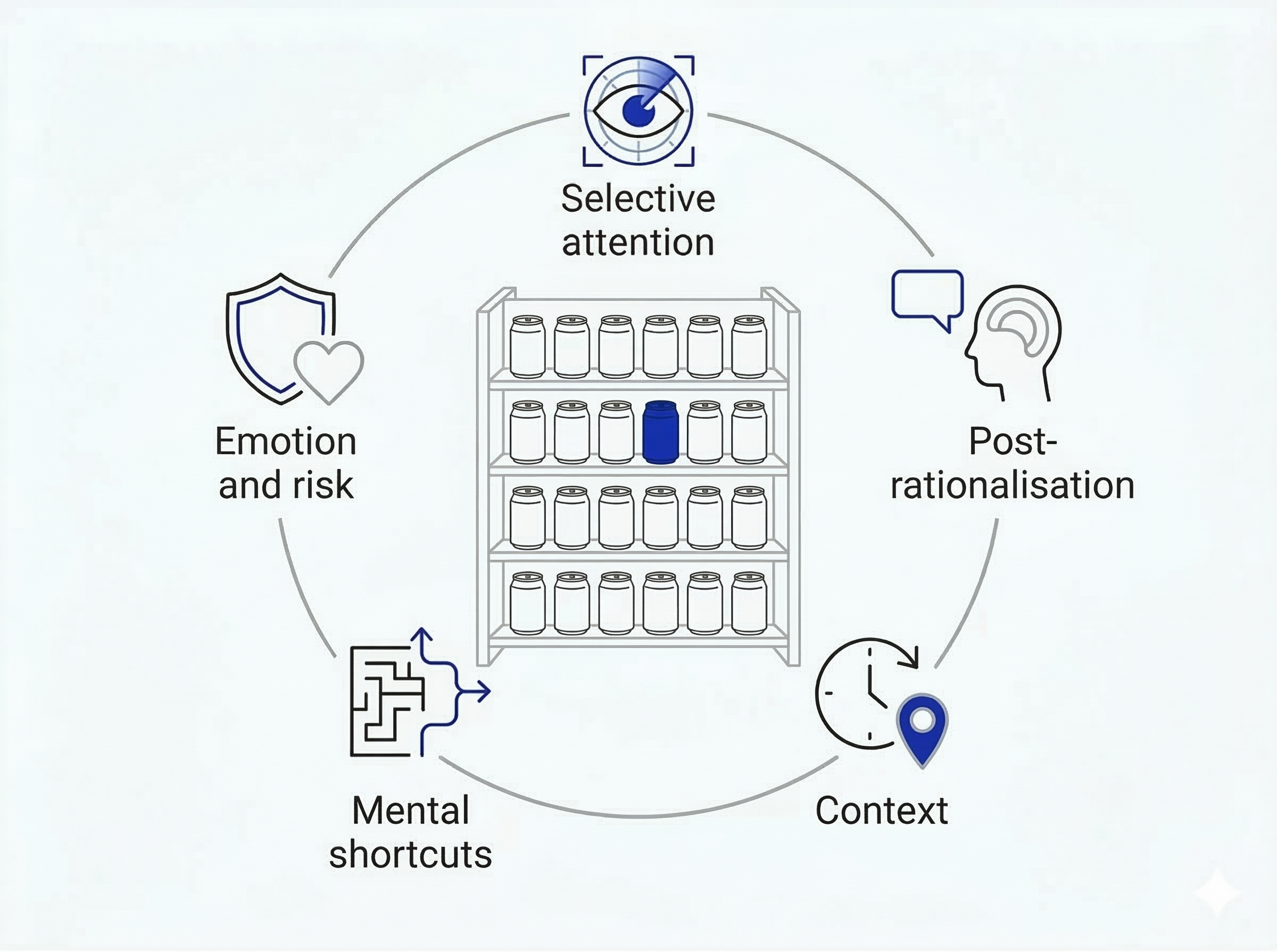
What feels right internally rarely works the same out in the real world.
Experience and creative judgment matter. But neither can tell you exactly how a pack will be noticed, understood and judged by a customer seeing it for the first time.
Testing brings your customer into the process, so you can see what’s landing, what’s being missed, and what needs fixing before you go to print.

why test?
Test with real customers in realistic buying conditions
If you want a true read on pack performance, your testing must reflect how decisions are made in the real world. Not slowed down, over-analysed, or stripped away from the retail context.
Behavioural pack testing recreates realistic buying conditions to uncover what’s working, what’s being missed, and what needs to change to increase pick-up and purchase.

How do shoppers instinctively categorise and label the product?
Interpretation

Trust
Does the pack build trust and reassurance, or trigger doubt?

Once picked up, what’s driving the final decision, or getting in the way?
Evaluation
Does the pack break through in a crowded shelf?
Visibility

Clarity
Is it immediately obvious what the product is and why it matters?

Appeal
Is it making people want to pick it up?

What’s it best for?
Retail launches - You know D2C and retail are different beasts, but you want to understand what to keep, what to change, and what the pack needs to do differently in retail.
Low trail - Trial is lower than it should be. You know something isn’t quite right, but you want clarity on what’s holding the pack back before making changes.
Pre-print decisions - You might feel close, or you’ve been going round in circles, but you need some more evidence and clarity that you’ve got things right before you go to print.
Behavioural pack testing is most useful for teams who want to ensure their design work is solving the right challenges and has clarity and confidence before making an important packaging decision.

